Buying guide · Polarized
Less glare. More useful information.
Polarized lenses reduce glare reflected by water, roads, snow and other flat surfaces. But the same lens is not ideal for every situation.
Choose by use ↓
How it works
Polarized does not simply mean darker.
A dark lens reduces light. A polarizing filter manages much of the horizontal reflection from flat surfaces, often making vision more comfortable and details easier to read.
Without a polarizing filter
Glare from water or road competes with the details in the scene.
With a polarizing filter
Distracting reflection is reduced, making contrast and surface easier to distinguish.
Important: polarization and UV protection are different functions. Always check that the lens provides suitable UV protection.
Drive · Water · Sport
Start with where you will wear them.
Collection gender matters less than fit, coverage and the lens your activity requires.

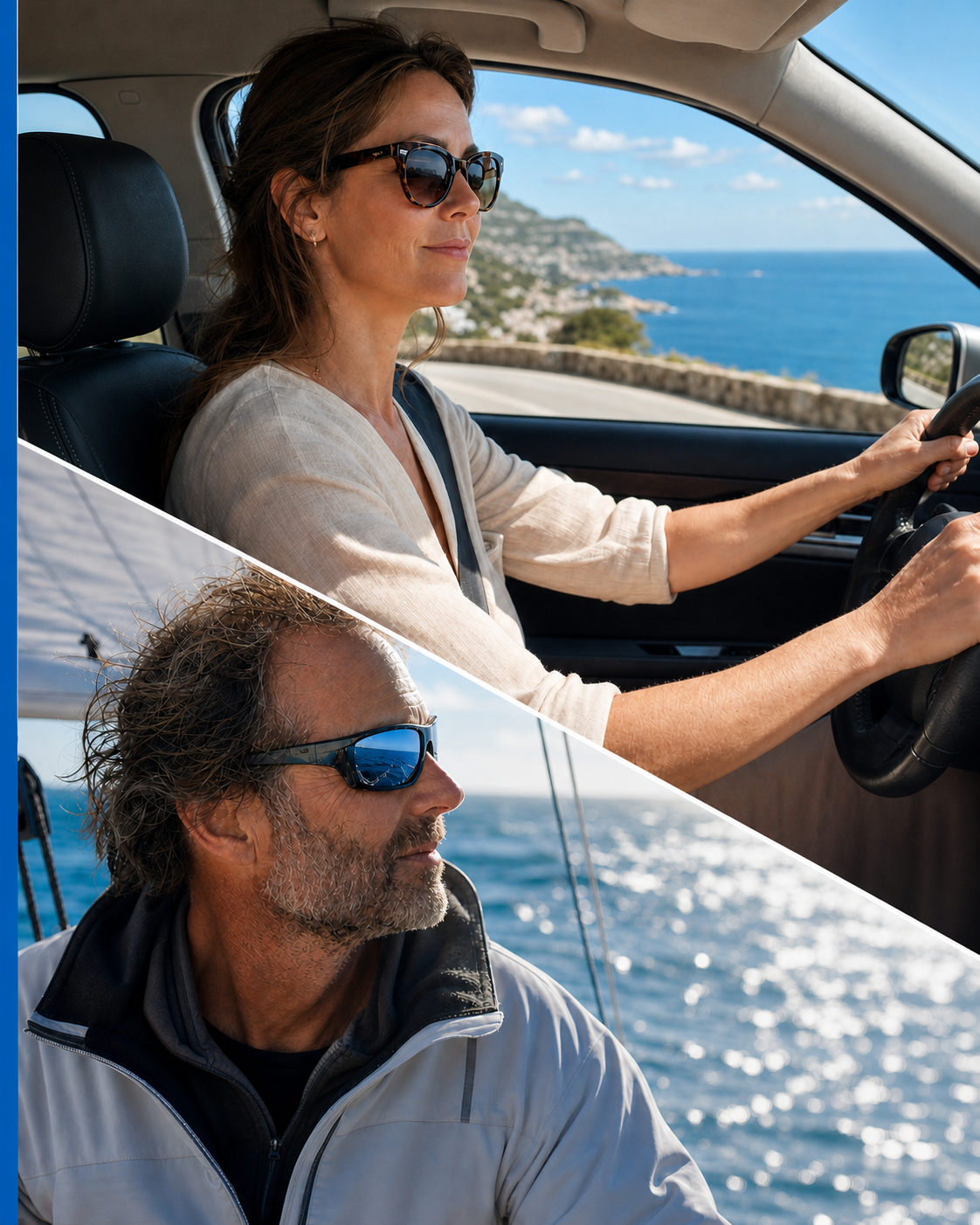
Road and everyday use
Polarization can help with reflections from wet roads, dashboards and metal surfaces.
Check LCD displays before choosing.
Sea and high exposure
This is where polarization is most obvious: it reduces horizontal glare across the water.
Prioritize coverage, grip and durability.
Movement and contrast
The frame must stay stable and the lens must suit terrain, speed and changing light.
Fit, ventilation and lens colour matter.Use matrix
A lens for every setting.
There is no universally best colour. Use this as a starting point and adapt it to sensitivity, prescription and real conditions.
Driving
Grey or brownPolarized · driving-suitable categoryAvoid category 4; check signals and displays.Water
Grey, green or mirrorPolarized · high coverageLook for glare control and side protection.City
Grey, green or gradientPolarized optionalBalance comfort, natural colour and screens.Sport
Brown, copper or sport-specificPolarized by disciplineContrast, ventilation and stability first.Fit over labels
Men or women? Start with measurements.
Gender labels organize the catalogue; geometry and comfort decide the right frame.
The front should follow the face without pressing the temples.
Stable, without sliding or concentrating all the weight.
More wrap for water and sport; more open for the city.
Secure without marking, and helmet-compatible when needed.
Before checkout
Five checks before you buy.
Polarization is only one part of the decision. Review the whole system.
Do not infer it from darkness or polarization.
Rotate the lens in front of an LCD: it may darken at some angles.
Category 4 is not suitable for driving.
Confirm compatibility with your prescription and frame curve.
Test outside with the light and devices you will use.
Maui Jim · Oakley · Ray-Ban
Three approaches to polarization.
Compare technology and frame design by context, not only by logo.
FAQ
Polarized sunglasses frequently asked questions
What is the difference between polarized and UV400?
Polarization reduces reflected glare; UV protection filters ultraviolet radiation. Good sunglasses should state UV protection even when polarized.
Are polarized sunglasses better for driving?
They can reduce road and dashboard reflections. Check that the filter category is suitable for driving and that vehicle displays remain readable.
How can I tell if sunglasses are polarized?
Rotate them in front of an LCD or another polarized lens; the view usually darkens at certain angles. An optician can verify it reliably.
Can polarized sunglasses be prescription?
Yes. Many prescription sun lenses are available polarized, depending on prescription, frame and curvature.
Are men's and women's polarized sunglasses different?
The optical function is the same. Fit, bridge, coverage, style and intended use are what matter.
Technical sources: ZEISS Polarised Lenses · ZEISS UV and Glare Protection