
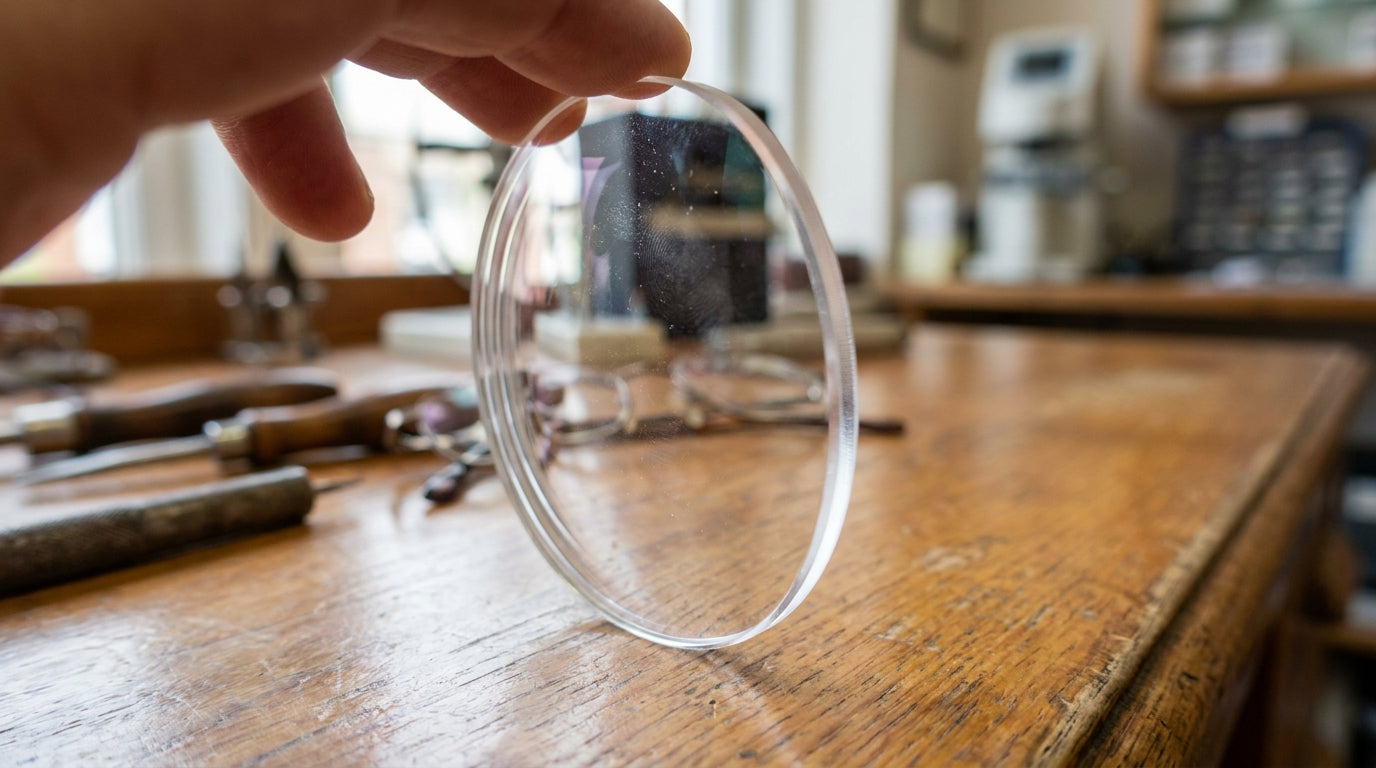
Progressive glasses price 2026: table by range and where to save without losing quality
Updated · May 2026 · By the OpticalH optical team
How much do progressive glasses cost in 2026?
Progressive glasses in 2026 range from €280 to €1,500 per complete pair (frame + two progressive lenses + treatments). The average in Spanish opticians ranges between €400 and €700. The significant difference is made by the lens range (entry-level, mid, or premium) and the treatments. There are areas where you can save without losing quality — and others where cutting costs guarantees you won't adapt and will waste your money. In this guide, we show you the real market prices, what you pay for exactly in each range, and where it's worth saving. Configure my progressive glasses →.
What you'll read
- Real 2026 prices by range (entry-level, mid, high, premium)
- What exactly your money is spent on: lens, treatments, frame
- Where you can save without losing quality — and where never
- What real customers report after 6 months with each range
- Quick comparison Varilux vs Hoya vs Zeiss vs Indo
- How to configure your progressive glasses online with a budget before paying
Real prices of progressive glasses by range 2026
These are the usual prices in opticians in Spain, for a complete pair (frame+2 progressive lenses + standard anti-reflective coating). Without special discounts.
| Range | Lens example | Total price | Who is it for? |
|---|---|---|---|
| Entry-level | Varilux Liberty 3 / Hoya Lux / Essilor Steady | €280-€420 | Low presbyopia, occasional use, first pair. |
| Mid-range | Varilux Comfort Max / Hoya Lifestyle 3 / Zeiss SmartLife Easy | €450-€720 | Normal life, moderate presbyopia, second pair. |
| High-range | Varilux Physio / Hoya MyStyle V / Zeiss SmartLife Individual | €750-€1,100 | Intensive use, screens all day, advanced presbyopia. |
| Premium | Varilux XR Series / Hoya MyStyle V+ / Zeiss SmartLife Individual 3 | €1,100-€1,500 | Visual professionals, high demands, perfect first impressions. |
* Estimated prices for a complete pair (frame+2 progressive lenses+standard anti-reflective coating) in specialized opticians in Spain, 2026. The frame can increase the total depending on the brand (Ray-Ban +€120, Persol +€150, Lindberg +€300 compared to average).
What the money is spent on (3 parts)
1. The progressive lens (50-70% of the price)
The biggest factor in the price. The higher the range:
Wider field of vision: with premium lenses, you see clearly in a wide area; with entry-level, only in a narrow strip, and you have to move your head more.
Less peripheral distortion: with premium lenses, the blurry side area is minimal.
Individual personalization: with premium lenses, the lens is cut with your actual measurements (pupil position, vertex distance, gaze behavior). With entry-level, it's standard.
Adaptation time: 3-7 days for premium; 15-25 for entry-level.
2. Treatments (10-25% of the price)
Quality anti-reflective coating (Crizal Sapphire, Hoya Hi-Vision Meiryo, Zeiss DuraVision Platinum): adds €50-€120. Essential for progressive lenses.
Blue light / screen filter: +€30-€60. Recommended if you work on a computer for more than 5 hours/day.
Photochromic coating (Transitions, Sensity, PhotoFusion): +€90-€150. Useful if you don't want to carry two pairs of glasses.
Hard coating (anti-scratch): comes standard on all modern ranges. Don't pay extra for it if they try to sell it to you.
3. The frame (15-40% of the price)
Basic frame (unbranded acetate or mid-range brand): €50-€120.
Mid-to-high-end brand frame (Carrera, Police, Hugo Boss): €130-€250.
Premium frame (Ray-Ban, Persol, Tom Ford, Oliver Peoples): €200-€400.
Luxury frame (Lindberg, Cartier, Chanel): €400-€1,500.
And where NEVER to cut costs
Yes, you can cut costs here
The frame: a mid-range brand (Police, Tommy Hilfiger) works just as well as a premium one for most people. Savings: €100-€200.
The photochromic coating: if you already have separate sunglasses, you don't need this feature. Savings: €90-€150.
The blue light filter: if you don't work with screens all day, you can skip it. Savings: €30-€60.
Downgrading the lens range: if your presbyopia is mild and you have normal usage, a mid-range lens (Varilux Comfort Max) does an excellent job. Savings: €200-€300.
DO NOT cut costs here (it's expensive)
Quality anti-reflective coating: with a cheap one, reflections in the visual corridor ruin the experience and make the progressive lenses useless.
Individual measurements: vertex distance, optical center, pupil height, pantoscopic tilt. Without these, the lens doesn't work — it causes headaches and you'll abandon the glasses.
The optician who makes them for you: someone who knows how to measure and check for adaptation. The extra €30-€50 for good service is offset by zero adaptation problems.
Updating your prescription: if your prescription is 3 years old, getting progressive lenses with it is a waste of money. Get it checked first — at OpticalH, the eye exam is free.

What people report after buying
Summary of what we see from real customers after several months with their progressive glasses (several thousand pairs sold annually across our opticians):
In entry-level: 65% adapt without problems, 25% notice a narrow field of vision but get used to it, 10% need a change or give up.
In mid-range: 88% adapt within 1-2 weeks and have no further problems. This is the range with the best satisfaction/price ratio.
In premium: 96% adapt within 3-7 days. Those who switch back to a lower range after trying a premium one are very rare.
Headache problems are almost always due to: outdated prescription, poorly measured centering, or frame that is too small (internal height <28 mm).
Premium brands in a nutshell
| Brand | Top of the range | Estimated price (2 lenses) | Strengths |
|---|---|---|---|
| Essilor (Varilux) | XR Series | €600-€900 | Very fast adaptation, wide field of vision. |
| Hoya | MyStyle V+ | €550-€850 | Excellent for screens and work in mixed lighting. |
| Zeiss | SmartLife Individual 3 | €600-€900 | German quality, best for driving and natural light. |
| Indo | Maxima | €350-€550 | Good value for money, Spanish manufacturer. |
Configure your progressive glasses online (with a budget before paying)
At OpticalH, you have a configurator that asks for your prescription, range, and treatments. It shows you the total price before paying — with no extra charges at the end. If you're unsure between two ranges, call us at +34 922 631 532 or WhatsApp, and we'll tell you which one fits your actual usage and budget.
The takeaway
A complete pair of progressive glasses costs between €280 and €1,500 depending on the range. The mid-range (€450-€720) is the sweet spot for quality and price for most people: 88% adapt within 1-2 weeks. Where you can save: frame and photochromic coating. Where NEVER to cut: quality anti-reflective coating and individual centering. At OpticalH, you can configure online and see the price before paying.
What we get asked most
How much do progressive glasses cost in 2026?
A complete pair of progressive glasses (frame + two progressive lenses + treatments) costs between €280 for entry-level and €1,500 for premium range with a designer frame. The average in Spanish opticians is between €400 and €700 per complete pair.
Are there affordable progressive glasses worth buying?
Yes, starting from around €250-€300 per complete pair with Varilux Liberty, Hoya Lux, or Essilor Steady lenses, a medium-quality frame, and standard anti-reflective coating. Below that, essential treatments are usually cut or they are fitted without personalized measurements, leading to adaptation failure.
Why do some progressive glasses cost €300 and others €1,500?
Due to three factors: the lens range (entry-level vs. premium), the degree of personalization (standard lens vs. cut to your actual measurements), and treatments (basic anti-reflective vs. Crizal Sapphire, blue light filter, photochromic). The frame usually accounts for 20% to 40% of the price.
Is it worth paying more for a premium lens like Varilux XR Series?
Yes, if you spend more than 5 hours a day with your glasses, work with screens, or have a high prescription. The premium lens has a much wider field of vision, less peripheral distortion, and adaptation in days instead of weeks. If you only use them occasionally, a mid-range lens (Varilux Comfort Max or Hoya Lifestyle) is equally or better.
Do cheap progressive glasses cause headaches?
It's not the progressive lenses themselves that cause headaches, but rather poorly centered or incorrectly prescribed ones. A well-measured entry-level lens is perfectly functional; a poorly measured premium lens will also cause discomfort. Professional centering matters more than the brand.
Where can I cut costs without affecting quality?
On the frame (you can choose a mid-range brand instead of premium), on the blue light filter if you don't work with screens all day, and on the photochromic coating if you already have separate sunglasses. What you CANNOT cut: a quality anti-reflective coating and proper individual centering.
Does Social Security cover anything?
Only in very specific cases (under 16s with high prescriptions, presbyopia +6 diopters, and little else, depending on the region). There is no coverage for healthy adults. Some private insurance plans do cover between €100 and €300 per year for glasses.
Read more
The best polarized sunglasses for men and women in 2026: models by style (driving, city, sea, sport), real differences between formats, how to check if polarization is real, and where to buy with a...
The best polarized sunglasses for men and women in 2026: models by style (driving, city, sea, sport), real differences between formats, how to check if polarization is real, and where to buy with a...